Health systems have digitised the provider. Nobody has digitised the patient's own account of their life, and every attempt so far has started from monitoring rather than ownership.
Australians had a mental disorder in the last 12 months, 21.5% of adults
$220b
annual cost of mental ill health and suicide to Australia, around $600m a day
~46,000
registered psychologists, growing 4.1% a year, at 172 per 100,000 people
under half
of those with a 12 month disorder sought any treatment at all
ABS National Study of Mental Health and Wellbeing 2020–22 · Productivity Commission Inquiry into Mental Health 2020 · Psychology Board of Australia, November 2024
Thesis
Ownership is the defensible position.
Three structural bets, each of which gets stronger rather than weaker as the category matures.
One
Portability beats integration
Interoperability projects have been failing for two decades because they require institutions to cooperate. A record owned by the person moves between services without any of them agreeing to anything.
Two
Trust compounds
The value of the record is the honesty of what is in it, and honesty depends entirely on the person believing nobody is watching. Every competitor that adds monitoring degrades their own dataset. We cannot follow them there, and that is the point.
Three
The clinician is the channel
Consumer health apps burn money on acquisition and lose people in weeks. Contexa arrives through a service the person already attends, with a clinician who benefits directly from them using it.
Model
Services pay. People do not pay for their own record.
Indicative structure. Pricing is being tested through the pilot rather than assumed.
Segment
Who buys
Why they buy
Shape
Private practices
Practice principal
Better prepared sessions, less time reconstructing history, a differentiator for clients
Per clinician, per month
Community services
Programme or service manager
Continuity across a caseload with high turnover, and outcome evidence for funding renewal
Per seat, annual
Primary Health Networks
Regional commissioner
Continuity between commissioned services that do not share systems
Programme licence
Individuals
The person
Their own record, kept when they leave any service
Free, permanently
The free individual tier is not a growth tactic, it is the thesis. A record a person loses when they stop paying is not a record they own, and the whole argument collapses.
Person's app and practice portal, sharing one record. You can open it from this page, change something on one side and watch it appear on the other. Nothing is in clinical use and there are no users yet.
Design and policy groundwork
Consent architecture, clinical safety policy, privacy impact assessment and clinician training drafted, and built into the prototype rather than sitting beside it as documents.
Next: build to production
Two engineers, roughly six months, to take the prototype to something a practice can safely use. This is what the raise funds first.
Then: clinical pilot, then expansion
The test is specific and falsifiable. After four weeks, do people report feeling more prepared and more accurately understood, and does clinician reading time stay under the time it saves. If the answers are no, we would rather find out early and cheaply.
What we are not claiming
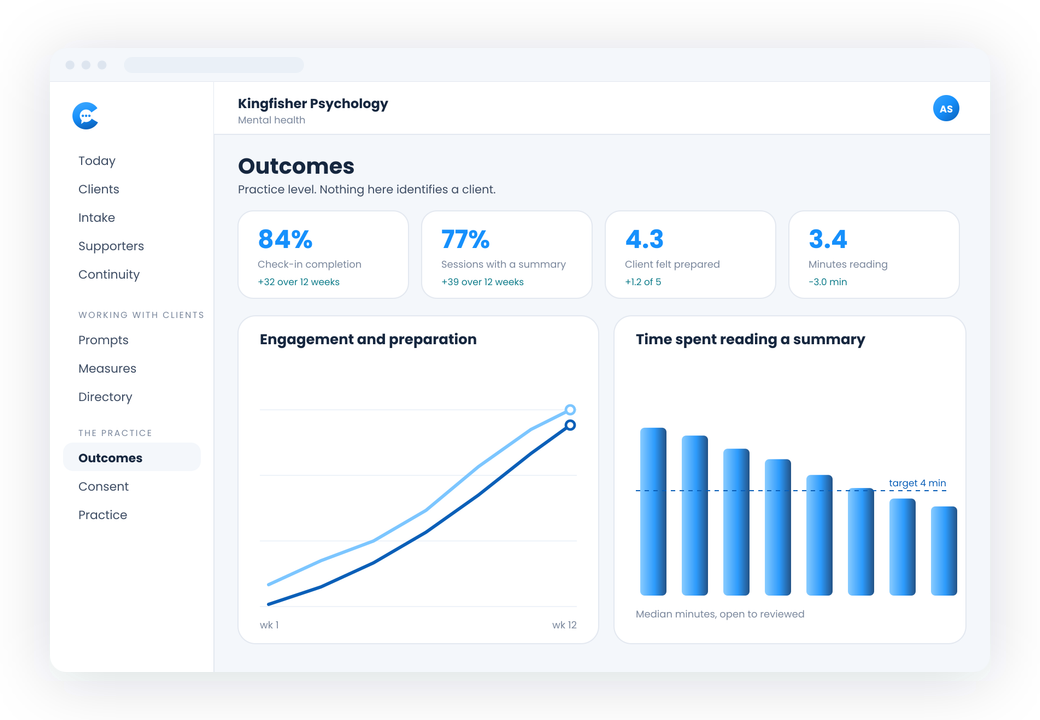
No users, no revenue, no pilot data and no outcome evidence yet. Every figure about how the product performs is a target we intend to be measured against, not a result. What exists is a prototype detailed enough that the design decisions are real and testable.
Risks
What could go wrong, stated by us first
You will find these anyway. We would rather you heard our answer alongside them.
Clinician adoption
Risk. Clinicians reject anything that adds minutes. Answer. Summaries arrive pre-approved rather than raw, and reading time is a headline metric we track and would act on.
Engagement decay
Risk. Self-tracking apps lose half their users in a month. Answer. The check-in exists to serve an appointment the person already has, which is a reason to keep going that a mood tracker does not have.
Regulatory drift
Risk. One feature turns this into a regulated medical device. Answer. The line is explicit in the product: no scoring, no triage, no treatment direction. Crossing it is a decision with governance work attached, not an accident.
Misuse
Risk. Supporter features weaponised in a controlling relationship. Answer. Designed against from day one, and covered in mandatory clinician training. It is a permanent risk to manage rather than a bug to close.
Incumbents
Risk. A practice management vendor bolts on a client diary. Answer. They can build the feature. They cannot make the record belong to the person without dismantling the model their customers pay for.
Trust, once
Risk. A single privacy failure ends the company. Answer. Correct, and we treat it that way. It is why there is no data sale, no model training and no monitoring, even where those would be commercially convenient.
The ask
$350,000 pre-seed, twelve months
To a production build, a completed independent privacy assessment, and a measured pilot with evidence at the end. Not to a bigger team or a longer runway.
Use of funds
Amount
Build Fixed price delivery with an established engineering partner, using the prototype as the specification
$120k
Clinical lead Part time psychologist with the authority to stop a feature, appointed before the build starts
$50k
Compliance and security Independent privacy impact assessment, penetration test, legal, terms and insurance
$60k
Pilot and evaluation Implementation support, clinician time and an independent evaluation partner
$50k
Hosting and operations Australian hosting, monitoring, app store and tooling for twelve months
$15k
Contingency Roughly fifteen percent, because something always costs more than the quote
$55k
Total
$350k
What it buys
A production build a practice can safely use
A completed independent privacy assessment
A pilot across a small number of practices
An answer to the four week test, either way
Who we are looking for
Investors comfortable with a clinical evidence timeline
Operators who have sold into health services
Introductions to Primary Health Networks and community programmes
Clinical advisors, especially psychiatry
People who will argue with the privacy model rather than nod at it
The full deck
Fourteen slides covering the problem, the product, the thesis, pricing, the risks and this ask. No form in front of it.