About
We started with a sentence, not a market.
Contexa exists because the same complaint kept surfacing, from people in care and from the clinicians trying to help them, and no product was answering it.
Contexa exists because the same complaint kept surfacing, from people in care and from the clinicians trying to help them, and no product was answering it.
A person living with a mental health condition is the only one present at every appointment, every bad night and every small recovery. They are also the only one with no record of any of it.
The GP holds ten minutes and last year's letter. The psychologist holds the sessions. The pharmacist holds the scripts. The family holds the mornings. Each fragment is real and none of them assemble, so the person in the middle is made responsible for carrying information between people who will not talk to each other, usually on their worst day.
Then the questions start. When did that begin. Has it been getting worse. How is the new dose. And a fortnight of actual life gets compressed into "not too bad, I think", because that is what recall does under pressure.
The obvious product is a monitoring tool. Watch the person, score their risk, alert somebody. It demos well, it sells to services, and it makes the person the object rather than the author.
We think that is the wrong instinct, and that it is why so many of these tools get abandoned inside a month. People stop telling the truth to something that reports on them.
So Contexa starts from the opposite end. The record belongs to the person. It travels with them. Nothing reaches anyone else without a decision they made, and that decision can be undone.
These are not marketing lines. Each one has cost us a feature that would otherwise have made the product easier to sell.
Not the service, not us. It survives a clinician leaving, a service closing or a move interstate.
Every category is its own decision, everything expires, and withdrawal needs no explanation.
No risk rating, no triage, no ranking. A number attached to a person changes how they are treated before anyone has spoken to them.
It can summarise and translate. It cannot diagnose, cannot alert and cannot send. Every output says where it came from.
Sleep, work, money, family and connection sit next to mood, because that is where the pattern usually is.
If it only works when someone is already coping, it does not work.
The same structure applies far more widely, and that is exactly why we are not building it yet.
Mental health has the widest gap between what happens to a person and what any clinician can see. Symptoms fluctuate daily, treatment response takes weeks to read, and the most important information is subjective by nature.
It is also the area where being reduced to a file does the most damage, and where the phrase "start from the beginning" is heard most often.
Addiction recovery, chronic illness, disability, aged care, paediatric care and family support all share the same shape: a person moving between services that hold fragments.
None of them get built until the mental health product is genuinely working. A platform that is shallow across six areas helps nobody. We would rather be right in one.
Every product in this space overclaims. Here is the list we hold ourselves to, stated as plainly as we can manage.
It is a person's own account. Nothing in it has been verified by anyone else, and the practice portal says so on every summary.
Nobody is watching. We repeat this inside the product, next to the crisis numbers, because ambiguity here is dangerous.
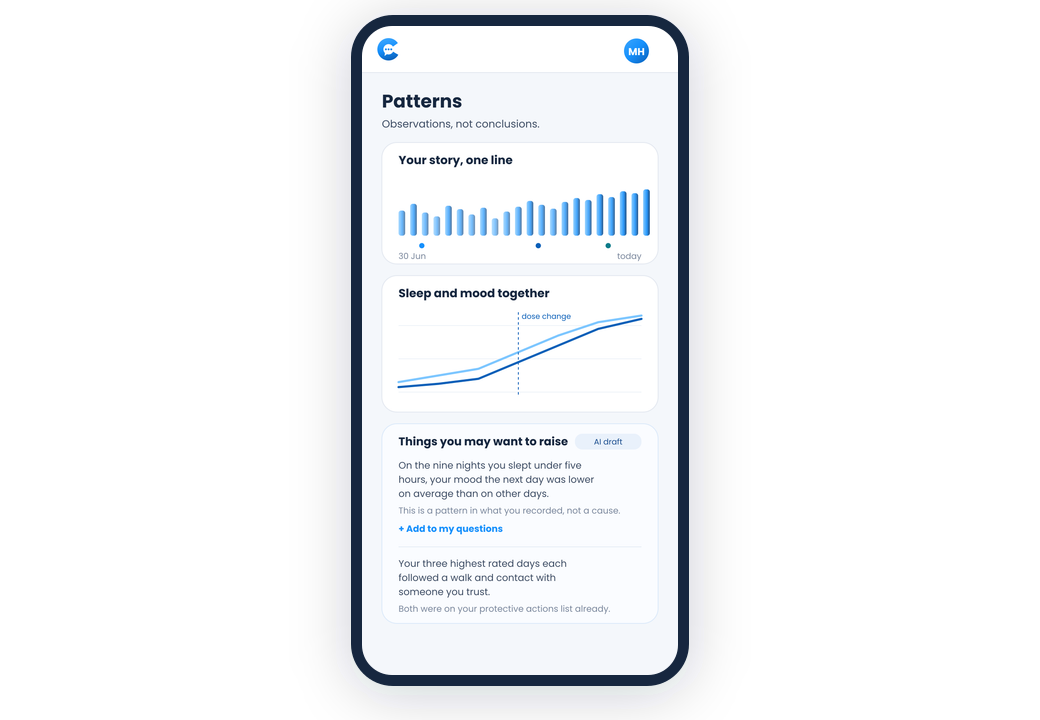
Contexa observes patterns in what someone recorded and says explicitly that a pattern is not a cause.
It makes the appointment better. It does not reduce how many are needed, and we will not claim it does.
Nobody can be added as a supporter except by the person themselves. A supporter never sees check-in answers, journal entries or location. Access can be withdrawn instantly and silently, and the supporter is not told. Clinicians can see an arrangement but cannot alter it, and their training covers asking the person alone.
It is the risk that kills products like this. A summary is written and approved by the client rather than dumped raw, and median reading time in the demo practice sits under four minutes. We measure that number and publish it internally, because if it goes above the time it saves, the product has failed.
The person reads it before anyone else does and can edit every line, untick individual facts or switch whole sections off. Every AI output is labelled as a draft and states it can be wrong. Clinicians can report a misleading summary through a form in the portal, which is logged and escalated.
As built, no. It records, organises and presents a person's own account without diagnosing or directing treatment. Validated questionnaires are presented alongside a person's words rather than driving decisions on their own. The moment a feature would cross that line, the clinical governance work happens first.
The intended model is services and programmes rather than people in distress paying for their own record. Individual access to a person's own account is not something we intend to put behind a paywall. Commercial detail sits on the investors page.
A clinician sees only what was shared, when they open it, in working hours. Nothing pages anyone. Existing clinical escalation processes apply exactly as they would for anything said in a session, and the portal points to them rather than pretending to replace them.